This month, Gardening Gone Wild's Design Workshop topic is “Pets in the Garden.” During the past year or so, I have had many visitors to my garden. First, there are the regular inhabitants, our pets. This is Blitzen, our dachshund, right where she likes to be – right in the middle of my garden! She’s entitled though as she once caught a mole!

And this is Stormy, our cat. She’s lounging on our porch.

Here are the imports:

I’ve got 12 koi and I’ve never had a problem with birds, racoons or other predators bothering this pond and for that, I am very thankful!
I also have occasional visitors to my garden who are predators! Each Spring, these guests arrive and stay through late October.


It’s an Alligator Snapping Turtle. It lives in the little stream that flows through the back of my yard and comes up each Spring to lay its eggs. Ours is a good two feet in length! I am always alerted to the turtle’s arrival by our barking dachshund. And yes, once I discover this beast in my yard, the dog must go inside! It is not fun herding a snapping turtle away from the koi pond!
Little box turtles also travel through on occasion and they are always welcome.
Perhaps the most plentiful “pet” in our yard is this …
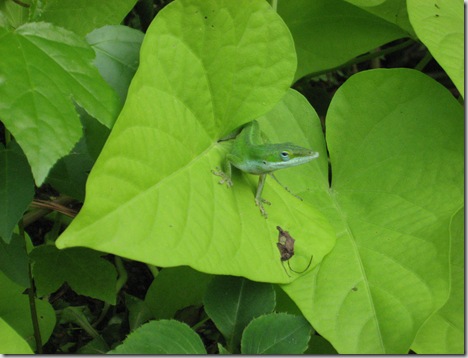
It’s a Carolina Anole and they are all over my garden. They have the ability to change colors from green to brown and so forth. Every now and then I find their eggs at the base of a plant I’m transplanting or digging around. We like to put them in a terrarium and wait for the little lizard to hatch! Then we release it back into the yard. They have been the source of much fun and amusement for my children and their friends throughout the years.
One summer my youngest son found this in our yard …
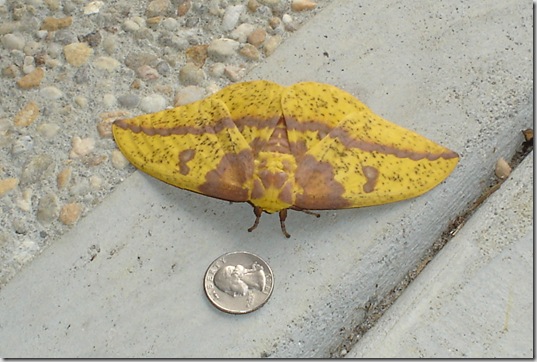
It’s an exotic-looking moth, and big too. I know I’ve mentioned this website before, but if you ever want to identify the bug in your yard go to What's that Bug? It’s a great website that will allow you to I.D. any kind of insect you can imagine.
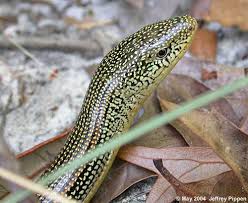
I found this little guy last summer. He is an Eastern Glass Lizard. Although legless, he is not a snake!
Finally, like many others, we have tons of bluejays, cardinals and other birds, as well as squirrels and of course, deer. Once the deer ate some of my daylilys that I inadvertently planted near the woods. I don’t mind this as I feel that we are fortunate to live in a wooded environment where we can enjoy them. That said, I do try to plant plants in my garden that I know the deer won’t eat. And those plants that I value such as my prize daylilys, and know that the deer will eat, I plant very close to the house in an area where I believe the deer won’t attempt to go. So far, I have had very little damage from deer, except for my sweet potato vine. They do love the sweet potato vine! But my attitude is so what -- it grows almost as quickly as kudzu! How does the saying go? Pruning promotes growth!
I strongly believe in designing with nature. If you don’t want animals and deer in your yard eating your plants, than you have three choices. First, don’t choose to live in their habitat or environment. Why people move to the country and then put up electric wires to keep the deer out is beyond me. Second, you can build a fence to keep them out. Third, choose to plant those plants that the deer won’t eat! There are many sources on the Internet that will list those plants to avoid using. Here is one site from the University of West Virginia: Resistance of Ornamentals to Deer Damage.

And this is Stormy, our cat. She’s lounging on our porch.

Here are the imports:

I’ve got 12 koi and I’ve never had a problem with birds, racoons or other predators bothering this pond and for that, I am very thankful!
I also have occasional visitors to my garden who are predators! Each Spring, these guests arrive and stay through late October.

The Osprey or Sea Hawks arrive in early Spring around March/April and get to work right away reinforcing their nest. All summer long we have been lucky to spy on the pair raising up their family of two to three chicks. They are expert fishermen. Sometimes the parent will catch a fish and perch in a tall pine to feast on it. We enjoy watching them from our porch. They are very noisy. The chicks are constantly squawking for their parents, who oddly enough sound like chicks! They peep!
Sadly, my neighborhood association elected to cut down their nesting tree last fall as it had been struck by lightning and a neighbor was fearful that it would fall on her house. I’m hoping they’ll come back this Spring and find a new tall pine tree to build in. If you are interested, visit The Dennis Puleston Osprey Fund to watch their Osprey Cam and see the birds in action. It is not filming at this time because the birds are away for winter, but there is footage on the site from seasons past.
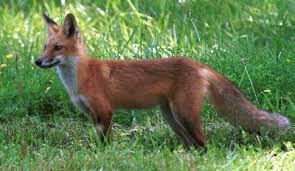
We also have seen Red Foxes in our yard.
The Red Fox is an animal that lives on the edge. Our yard is adjacent to a heavily forested area where there is an edge delineated between the wooded area and our yard. Although we only cut a few trees down when we built our home, most of the good ones had already been knocked down by a hurricane.
We’ve heard from our next door neighbors that they have seen Coyotes. Thankfully, we haven’t seen them in our yard … yet!
Our next guest has visited our yard every Spring for the past three years!
It’s an Alligator Snapping Turtle. It lives in the little stream that flows through the back of my yard and comes up each Spring to lay its eggs. Ours is a good two feet in length! I am always alerted to the turtle’s arrival by our barking dachshund. And yes, once I discover this beast in my yard, the dog must go inside! It is not fun herding a snapping turtle away from the koi pond!
Little box turtles also travel through on occasion and they are always welcome.
Perhaps the most plentiful “pet” in our yard is this …

It’s a Carolina Anole and they are all over my garden. They have the ability to change colors from green to brown and so forth. Every now and then I find their eggs at the base of a plant I’m transplanting or digging around. We like to put them in a terrarium and wait for the little lizard to hatch! Then we release it back into the yard. They have been the source of much fun and amusement for my children and their friends throughout the years.
One summer my youngest son found this in our yard …

It’s an exotic-looking moth, and big too. I know I’ve mentioned this website before, but if you ever want to identify the bug in your yard go to What's that Bug? It’s a great website that will allow you to I.D. any kind of insect you can imagine.
I found this little guy last summer. He is an Eastern Glass Lizard. Although legless, he is not a snake!
Finally, like many others, we have tons of bluejays, cardinals and other birds, as well as squirrels and of course, deer. Once the deer ate some of my daylilys that I inadvertently planted near the woods. I don’t mind this as I feel that we are fortunate to live in a wooded environment where we can enjoy them. That said, I do try to plant plants in my garden that I know the deer won’t eat. And those plants that I value such as my prize daylilys, and know that the deer will eat, I plant very close to the house in an area where I believe the deer won’t attempt to go. So far, I have had very little damage from deer, except for my sweet potato vine. They do love the sweet potato vine! But my attitude is so what -- it grows almost as quickly as kudzu! How does the saying go? Pruning promotes growth!
I strongly believe in designing with nature. If you don’t want animals and deer in your yard eating your plants, than you have three choices. First, don’t choose to live in their habitat or environment. Why people move to the country and then put up electric wires to keep the deer out is beyond me. Second, you can build a fence to keep them out. Third, choose to plant those plants that the deer won’t eat! There are many sources on the Internet that will list those plants to avoid using. Here is one site from the University of West Virginia: Resistance of Ornamentals to Deer Damage.